Showing posts with label Massey. Show all posts

Tuesday, December 1, 2015

"Why I hate Notting Hill Carnival"


I found the brief mentions of crime that surrounded Notting Hill intriguing, and I found it even more interesting that I couldn't find it mentioned as a warning or downside in the countless travel website posts about Notting Hill. After doing a little more digging, I found the following article from a black male from London on why he hates Notting Hill. 


This is an account of a black male from London, who expresses his disdain for the modern Notting Hill.


Why I Hate Notting Hill Carnival

August 20, 2014
by Joshua Surtees


Photo by Chris Bethell
I'm not afraid to say it – I've always hated Notting Hill Carnival. Granted, it's lucky that I'm black; If I were white, I'd run into a whole world of shit writing this. Lots of people out there share my view but won't say it for fear of appearing racist. I, on the other hand, can say it loud and proud: I hate Notting Hill Carnival.
I may be called a traitor or "choc ice" – to use Rio Ferdinand's basic terminology – but look, this isn't the 1970s. It's 2014 and if anything, I'm a Milky Way bar. Chocolate on the outside with a light, fluffy nougat centre.
My disdain dates back to childhood. Our father would take my brother and I to the kids' parade and not bring us home to our mum until late at night, way past the agreed time. Which annoyed her so much she eventually banned him from taking us.
Reminiscing this week, she told me: "The first time I went to Carnival was with Leabert [my dad]. We ended up running away from bricks being thrown everywhere under the underpass. So, no fond memories for me."
By the time I reached my teens I was thankful Carnival coincided with Reading Festival so I could get the fuck out of town. Sadly, Reading is now utterly appalling, too.


Photo by Jake Lewis
In the past, my aversion to Carnival was instinctive – a get-me-out-of-here-and-away-from-all-these-people kind of response. But now, having lived in Trinidad for a year, and seen what real Carnival is like – a spectacular show of beauty, music, wild abandon and modernity reinterpreting tradition – I am even more certain of my feelings: Notting Hill is not a Carnival. It's just loads of people being silly in West London.
The massed bodies, awful clothes, stilted behaviour, slightly ashamed body language, the piss, the arrests, the weather, the traffic, the concrete, the white Rastafarians, fat jolly policemen being twerked on by big black women (fuck off and arrest someone), even the Carnival costumes – however admirable an attempt, it's all rather embarrassing.
Then there's the sinister side. The part of Notting Hill Carnival that reflects underlying tensions, mostly ignored in the day-by-day. For two days a year, white, middle-class liberals visit Notting Hill for black tourism. This year the Daily Telegraph even has a guide to it in its travel section. They all have a great time acting "black", dancing "black", eating, drinking and smoking "black".
That's all very positive, I suppose. The problem arrives the next day, when most of those white fans of black culture will go back to the depressing default position of being nervous around black people – especially in places like rapidly gentrifying Hackney. Notting Hill is itself an example of extreme gentrification, and one of the first areas to have experienced it. No black people live in Notting Hill or Ladbroke Grove now. People from Huntingdonshire do.


Photo by Chris Bethell
Meanwhile, as the poshos on pills revel in the streets, buying warm cans of Red Stripe for £3.50 and pissing in somebody's garden for a fiver, black men are openly stopped and searched by police for being genuinely, quite unmistakably, black. The crowds of woolly liberals stand and stare, appalled and confused but impotent to act.
This is hugely problematic and I doubt it was what Claudia Jones, the woman who launched Carnival in 1959, intended. Jones – a Trinidadian who migrated to America at the age of nine, to later be deported for being a Marxist – wanted to give a positive spin on Caribbean immigration in the UK by importing the excitement of the tropics into cold, grey London.
Back then, Notting Hill was a deprived area that had received the Windrush generation. Those guys were attacked by Teddy Boys, spat at by random passers by and denied housing. Race riots took place in 1958 when mobs of white men, spurred on by Oswald Mosley, hunted down black men. Kelso Cochrane, an Antiguan law student, was stabbed to death on his way home by a group of white youths the following year; the first recorded racially-motivated murder in Britain.
It was 1966 when Notting Hill saw its first outdoor carnival. Jones had died in 1964, aged just 49, and was buried in Highgate Cemetery next to Karl Marx. Thank god she never had to see the kind of violence that marred the event in later years.


Photo by Jake Lewis
The last time I went, a few years ago, gangs of young boys were roaming around trying to stab or shoot each other. In Ladbroke Grove, the streets were jam-packed and the soundsystems were fantastic. At the top of the stairs leading up to every beautiful townhouse overlooking the street stood policemen wearing high-visibility jackets, hands behind their backs, surveying the scene. A gang of about 25 boys, all wearing Yankees caps, snaked through the crowd intermittently calling out "North London". A minute later, girls started screaming and boys started running. The huge crowd dispersed in a matter of seconds.
"What happened?" I asked somebody. "One of them must have pulled a gun," they replied. Later, in front of the soundsystem, the gang found their intended target – "East London" – and the rival gangs stood about ten-feet apart in a tense stand-off waiting for the first knife to be drawn.
It was anthropologically fascinating, and reasonably exciting after a few Wray & Nephews, though I don't think my then-girlfriend appreciated the fieldwork, cowering behind me as "North London" steamed in.
It was a far cry from Carnival del Pueblo (London's Latin America festival) where weeks before we'd been happily dancing to samba in the rain. Violence doesn't mar the real carnivals in Port-of-Spain, Rio de Janeiro and Salvador de Bahia. Trinidad and Brazil are violent societies with high murder rates but, during Carnival, there is a definite sense that criminals put the violence on the back burner as they're far too busy having a good time. In fact, research shows that in Carnival month, the number of murders in Trinidad actually drops. Britain is the complete opposite.


Photo by Jake Lewis
The heavy police presence alone is always a forewarning of trouble. That same year, police had stopped 100 youths from "South London" as they were about to enter the tube network at Elephant and Castle. Had they not been successfully detained, there may have been a murder that year. There have been five murders at Notting Hill Carnival between 1987 and 2004. One of them was a stabbing over some food.
The journalist, Alex Pascall OBE – founder of The Voice and host of the first black radio show on BBC Radio London – was a leading organiser of the early years of Carnival.
He won't like this article. When I spoke to him about it he told me that "the British press have always portrayed the carnival negatively. It's always about arrests – nothing tangible about the art, music and entertainment. Carnival has been the greatest medium for race relations."
But I still think it has damaged race relations by confirming the worst suspicions of racists. During our chat, Pascall went on to reveal more sinister things: "This year the police and others have decided to strategically push out some of the soundsystems by using bylaws," he told me. "I was once made an offer to assist the government to remove the carnival from the Royal Borough. They wanted me to take it to Brixton. Prior to that, they wanted it in Wormwoods Scrubs."


Photo by Chris Bethell
Cunts, yes, but can you really blame the establishment for wanting to take it somewhere that can be more easily policed? A tip Clive Martin alluded to in his "How to Conquer Notting Hill Carnival" article in 2012 was: "Get the fuck out of there before nightfall." If you don't, you'll be trapped in an alcohol-fuelled war zone which is absolutely typical of the way we British like to get on after a skinful. Sorry to keep going on about it, but in Trinidad, people drink 80 percent proof Puncheon rum and somehow manage to avoid headbutting each other.
So, what is the answer? Well, Norman Jay has organised Good Times in the Park for September; a two-day outdoor festival of soul, house, disco and dancehall in Wormwood Scrubs. If that goes down well, could it not act as a pre-cursor to a different, less urban, unrestrained kind of Carnival? The original 1960s idea was splendid. And it's still politically important that it exists.
But I'm not so sure on what Carnival has become and what it should be in the future. It's not "on trend" to be anti-Carnival right now – not with Major Lazer and the hipsters on board – and I don't want to be a contrary killjoy, but it's long overdue an overhaul. As it stands, Carnival is crying out for reinvention.


This article is from Joshua Surtees and was posted on vice.com and the link is provided above. 

Wednesday, November 11, 2015

Steelpan History

The steelpan is the national instrument of Trinidad and Tobago. It is the only new instrument to be invented in the 20th Century. As the manager of one of the most outstanding steelbands in England, Pepe Francis, has written this article in the hope of rectifying some of the myths surrounding the foundation and growth of steelbands from Trinidad and Tobago to England. 

The steelpan instrument was born out of a poor nation, oppressed by the European plantation owners who ruled Trinidad and Tobago at that time. For many of the oppressed of that era rhythmic music and dance was a refreshing past time. Instruments were self made from the tamboo bamboo (Tamboo being derived from the French word 'Tambour' meaning 'drum'). They were also made with bamboo and the biscuit drum, made from the drums that were used to pack biscuits by the Bermudez and Sunrise Biscuit Company. The conventional steelpans of today used to be created from the discarded oil drums left in the fields by oil companies. 

No one is sure who invented the first steelpan note and research is still being carried out by Fan Trinbago (the world governing body of steelpan) to try and establish the facts. There is however some general agreement that the instrument emerged in an organised form for the first time during the second half of the 1930s.


Some names that are associated with the creation of the steelpan as an instrument with notes, are Winston Spree Simon, Carlton Ziggily Constantine, Elliot-Manette and Philmore Boots  Davidson. Over the years, all the relevant parts of a conventional orchestra have been associated with the different types of steelpan instruments such as the Tenor Pan or Soprano as it is now known, the Cellos Pan, the Guitar Pan, the Bass Pan and so on. The steelpan was found to be a very effective and ,expressive instrument as it allowed more subtle and complex harmonies to be created. 

As technology (with regards to pan manufacture) improved and became more refined, cleaner and sharper notes were created from forty five gallon steel oil drums discarded by the oil companies. Today drums are specially made by "Van Leer" and other companies at great cost. 

Moreover, modern technology has come into the tuning of steelpan instruments; pan tuners now use a strobe-tuning machine instead of the old tuning fork method or as in the very early days, by ear. 


The Steelband in the early days was the main ingredient of Carnival. Each Steelband had a mas band attached to it hence the phrase 'Mass Et Pan is Carnival'. As time went on steelbands began playing different types of music other than calypso which included classical, jazz, R&B pop etc. which were picked up from the radio or from the Americans on the military base at Chaguaramas (West Trinidad). 

The growth of steelbands in Trinidad and Tobago gave rise to bands like Red Army Casablanca, Tokyo and Invaders to name but a few. Within a few months there were steelbands all over Trinidad which created great rivalry and conflicts between the hands. In the past being a panman was considered a 'badman'  due to the many conflicts between rival bands. However steelpan today is the national instrument of Trinidad and Tobago, and most people want to be associated with it. You can now get a scholarship to the United States or Canada from playing steelband music. 'Pan' to the Panman 'is like a Jumbee (spirit), it gets in your blood' as they say in Trinidad. 

By the 1950's there were over 50 steelbands in Trinidad, bands like Dixieland, Trinidad All- stars, Crossfire, Crossroads, Desperados, Northstars and from South Trinidad you had Sundowners, Southern Marines, Free French and Hatters to name but a few of the prominent and still respected hands, some of which went on to produce some of the great pannists, tuners etc, and are still doing so up to this time.


Above is a video that I found from the Trinidad Allstars Youtube channel with the following captioned: 


Perhaps the most popular panorama arrangement to have never won the competition - the 1987 ground breaking performance of Trini's Curry Tabanca, arranged by Leon 'Smooth' Edwards for the Trinidad All Stars Steel Orchestra. Listen for the seamless incorporation of East Indian Tassa instruments into the arrangement and the simulation of the tassa drums by the pan. Enjoy the excitement over and over again!

The History of Notting Hill Carnival


In Trinidad, during the days of slavery, slaves were forbidden to play musical instruments and wear costumes, apart from when the traditional imported European Carnival took place, six weeks before Easter. On those occasions their participation was limited to providing entertainment for the slave owners.

It was also known that slaves were forbidden to be in the streets after dark unless they were accompanying their owners. When the Laws were repealed and freedom from slavery was announced in 1833, the slaves took to the streets in song and dance, indulging in their culture and using their artistic skills to mimic their former owners and pour scorn on the system that had them enslaved for so long.

Consequently, slaves would dress like their previous owners, powder their faces to look pale like their masters or make masks to resemble their masters, distorting images and features if they regarded their masters as particularly evil or ridiculous.


  These celebrations of freedom provided the only opportunity for Black people to express their feelings about their slave owners and they quickly developed the art of costume making, creating fantastic costumes which satirized their situation as Africans, transported to the Caribbean as slaves. In Trinidad the tradition continued, going from strength to strength, as people from all over the island began to take part and associate themselves with Carnival. The skills of costume making, steel drumming and calypso became what today is a huge festival of arts and culture, of which Trinidadians everywhere are justifiably proud, drawing on all aspects of their cultural heritage from Africa and Europe.

  The arrival of Trinidadians in Great Britain, remembering their great Carnivals back home, provided the spark which ignited the Notting Hill Carnival. From a small procession through the streets with just a few people in costume and carrying steel drums in the 1960s, has evolved a huge multi-cultural arts festival, attended by up to two million people. It is a great tourist attraction that brings life to London during the month of August.


Coconut Punch

**This is best made with freshly grated cinnamon stick and whole nutmeg, and a fresh vanilla pod. However, you can use ground cinnamon and nutmeg, and replace the vanilla pod with a tablespoon of vanilla extract.**


Coconut Punch


SERVES


8-10
INGREDIENTS
200ml white rhum agricole (if you can’t find it, use a 6-12 year aged rum from any well-known brand)
400ml coconut milk
200g condensed milk
150ml cane syrup
2 pinches grated cinnamon
1 pinch grated nutmeg
grated zest of 1 lime
1 vanilla pod, cut in half lengthwise


METHOD
Put the rum, coconut milk, condensed milk and cane syrup in a large mixing bowl. Stir with a wooden spoon until rich and thick.
Add the cinnamon, nutmeg and lime zest. Using a small knife, scrape the seeds from the vanilla pod and add to the bowl. Stir until evenly mixed.
Using a funnel, pour the coconut punch into an empty rum bottle and place in the refrigerator for at least 2 hours. You can keep it in the refrigerator for up to 2 months.
Shake well before serving


{Recipe from Creole Kitchen, by Vanessa Bolosier. You can publish her book here. I can attest to this being a GREAT purchase with yummy dishes!! These are just a few of my favorites!!}

Coconut Roll Cake

Coconut roll cake

Salara, a doughy and sweet coconut bread, is a traditional cake sold on the streets in the Caribbean. This doughy, sweet coconut bread is rarely made at home as it is sold fresh and cheaply by bicycle vendors with their glass display cases on all the main streets.


It is delicious at any time of the day and much easier to make than it looks- huge bonus!!!

SERVES

12

INGREDIENTS

For the dough
  • 1 tablespoon active dried yeast
  • 75 ml (3 fl oz/scant B/d cup) warm water
  • 85 g (3 oz/B/d cup) caster (superfine) sugar, plus 1 teaspoon
  • 170 ml (6 fl oz/D/e cup) milk
  • 60 g (2 oz/W cup) lard or butter
  • 2 teaspoons vanilla extract
  • 675 g (1 lb 8 oz/5V cups) white bread flour
  • vegetable oil
  • 2 eggs, beaten
  • 2 tablespoons melted
  • unsalted butter
  • 1 tablespoon maple syrup
For the filling
  • 450 g (1 lb/5 cups) desiccated coconut
  • 225 g (8 oz/scant 1 cup) caster (superfine) sugar
  • 1/2 a teaspoon ground allspice
  • 1/2 a teaspoon ground cinnamon
  • 1 teaspoon mixed essence or vanilla extract
  • a few drops of red food colouring

METHOD

To make the dough, dissolve the yeast in the warm water in a small bowl. Mix in the 1 teaspoon of sugar, cover and set aside for 10 minutes.
Warm the milk until nearly boiling, add the lard or butter, and sugar. When the fat has melted and sugar dissolved, remove from the heat and let it cool until warm, then stir in the yeast and vanilla extract.
Slowly work in the flour with your index finger until a soft dough forms. Turn it out on to a lightly floured surface and knead until it is smooth and elastic.
Place the dough ball in a large mixing bowl greased with a small amount of vegetable oil and turn it around to oil all sides of the dough. Cover with clingfilm and leave in a warm place for at least 1 and a half hours until the dough has doubled in size.
Punch the dough down, cut in half and cover and leave for 10 minutes.
Preheat the oven to 190°C (375°F/Gas 5) and combine all the ingredients for the filling, except for the red food colouring, in a mixing bowl. Add enough drops of the food colouring to turn the mixture bright red.
Roll each half of the dough into a rectangle about 1 cm (1/2 in) thick and measuring about 25 x 33 cm (10 x 13 in). Brush with the melted butter. Smooth half of the filling mixture over each of the rectangles but not right up to the ends. Roll the dough up lengthwise and seal the edges and leave to prove for 45 minutes.
Brush the rolls with maple syrup and bake for 25–30 minutes.


{Recipe from Creole Kitchen, by Vanessa Bolosier. You can publish her book here. I can attest to this being a GREAT purchase with yummy dishes!! These are just a few of my favorites!!}

Salt Beef Stew

"The national dish of Grenada is so simple to make and is an exotic, one-of-a-kind type of stew. It is traditionally made with breadfruit (a fruit that, when cooked, tastes like, wait for it… bread) but I find that green, unripe bananas make a fabulous, exotic substitute in this recipe. The salt beef combines deliciously with the sweet coconut and spices, but salted pork (ham hock) also does the trick."


Salt Beef Stew 


SERVES

6-8

INGREDIENTS

  • 1kg uncooked salt beef joint
  • 2 tbsp rapeseed oil
  • 1 large onion, peeled and finely chopped
  • 1 celery stick, finely chopped
  • 2 garlic cloves, peeled and crushed
  • 1 tbsp chopped chives
  • 1 tbsp chopped thyme leaves
  • 1tsp ground turmeric
  • 2 x 400ml cans coconut milk
  • 200g spinach
  • 6 unripe, firm, green bananas, peeled and cut into 4cm-long slices
  • 1 Scotch bonnet pepper, unbruised and unpierced

METHOD

Pop the beef joint into a large pan, cover fully with cold water and bring very gently to simmering point. Skim off any scum from the surface, then reduce the heat to the lowest setting and continue to gently poach, with the lid on, for about 2-2½ hours, ensuring that the joint is always covered with water and skimming off any surface scum, until a knife easily slides into the joint. Remove the beef from the water and set aside.
Empty the water from the pan, add the oil and place on a medium heat, then add the onion and celery and soften with a pinch of salt, stirring often, for about 5 minutes.
Add the garlic, chives, thyme and turmeric and stir for 30 seconds, until the aromas are released. Add the coconut milk, spinach, green banana and Scotch bonnet and bring to the boil, then reduce to a simmer for 20 minutes, stirring occasionally (but gently so that you don’t burst the Scotch Bonnet). Remove the Scotch bonnet.
Chop the salt beef joint into 2.5cm chunks, add to the pot and continue to simmer gently, until the liquid has evaporated away and you are left with a thick gravy and the banana is tender and cooked through, about 15-20 minutes. Season to taste and serve immediately.


{Recipe from Creole Kitchen, by Vanessa Bolosier. You can publish her book here. I can attest to this being a GREAT purchase with yummy dishes!! These are just a few of my favorites!!}

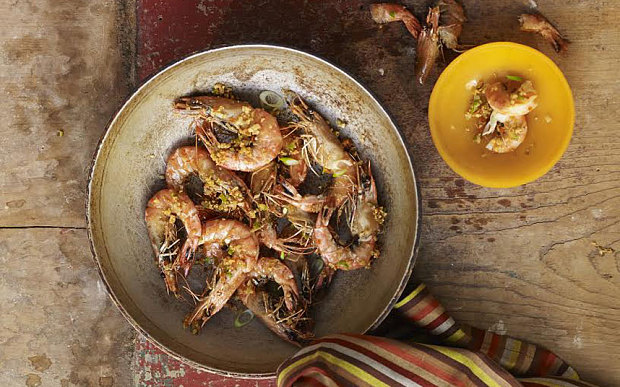
Spicy Garlic 'Pepper' Prawns


Punchy and colorful, Caribbean cooking is influenced by a myriad different cooking traditions and ingredients, brought by settlers from countries including Portugal, Spain, France and Britain. Columbus brought sugar cane for rum; okra and salt-fish came from West Africa; and spices and flat breads traveled from the Middle East. Native crops —such as corn, cassava, and sweet potatoes — were used with European, African, Middle Eastern and Asian flavors, to create full bodied, feisty dishes with a character all of their own.\

Food is a big part of the Caribbean culture, and the Notting Hill Carnival is no exception to this part of the culture. Caribbean food is rapidly becoming more popular everyday, and through out the archives I'm going to be including some of the favorite recipes from Carnival and how to make your own versions at home! 


SERVES

4–6

INGREDIENTS

  • 450g fresh or thawed frozen raw large king prawns (16–20), in shells with heads on
  • 1 Scotch bonnet chilli, chopped with seeds
  • 2 tablespoons sea salt
  • 475ml vegetable oil
  • 6 garlic cloves, diced
  • 25g spring onion, sliced
  • 1 teaspoon sugar

METHOD

Butterfly the prawns and remove the veins but leave the shells and heads on. Place in a bowl and rub the prawns with 1 tablespoon of the salt, then leave to stand for at least 30 minutes.
Heat the oil in a wok or frying pan over a medium-high heat. Add the prawns in batches and deep-fry for 40–60 seconds, then quickly remove from the oil with a slotted spoon and drain on kitchen paper. When all the prawns have been deep-fried, pour the oil out of the pan, leaving just 1 tablespoon.
Quickly sauté the Scotch bonnet, garlic, spring onions, sugar and remaining 1 tablespoon sea salt in small batches over a high heat for a few seconds. Add the prawns in batches, give them a quick toss to coat with the seasoning and remove quickly from the pan. Repeat until all the prawns are finished. Serve immediately.


{Recipe from Creole Kitchen, by Vanessa Bolosier. You can publish her book here. I can attest to this being a GREAT purchase with yummy dishes!! These are just a few of my favorites!!}